 Rumor & Record
MEMORANDUM / FILE 091
Iran
Contra
On October 5, 1986, a cargo plane full of rifles and grenade launchers was shot down over the jungle of Nicaragua. One crewman survived, an American named Eugene Hasenfus. Within two months, his capture had helped expose a secret that reached .43
Declassify the denial
0 of 6 declassifiedPresident Reagan addressed the nation about the arms sales twice from the Oval Office: once in November 1986 and again in March 1987. These lines are exact. We blacked out the key words. Tap each bar to declassify it.
THE PRESIDENT, NOV. 13, 1986. We did not—repeat—did not , nor will we.
THE PRESIDENT, NOV. 13, 1986. These modest deliveries, taken together, could easily fit into .
THE PRESIDENT, NOV. 13, 1986. …the wildly speculative and false stories about and alleged ransom payments.
THE PRESIDENT, MAR. 4, 1987. A few months ago I told the American people I did not .
THE PRESIDENT, MAR. 4, 1987. As I told the Tower board, I didn't know about .
THE PRESIDENT, MAR. 4, 1987. One thing still upsetting me, however, is that of meetings or decisions.
Source: Foreign Relations of the United States, 1981–1988, Volume I, documents 281 and 293, U.S. Department of State. U.S. government documents in the public domain.12
Two problems, one solution
In the mid-1980s, the Reagan administration had two problems it couldn't solve in public. Seven Americans were being held hostage in Lebanon by Hezbollah, a group with close ties to Iran.3
In Nicaragua, the administration backed the Contras, rebels fighting the country's left-wing government. But Congress passed a series of laws, the Boland Amendments, limiting that support, and from October 1984 it cut off U.S. military aid altogether.3
Some members of the National Security Council staff came up with an answer to both: sell weapons to Iran to help free the hostages, and send the profits to the Contras.3
Missiles for Tehran
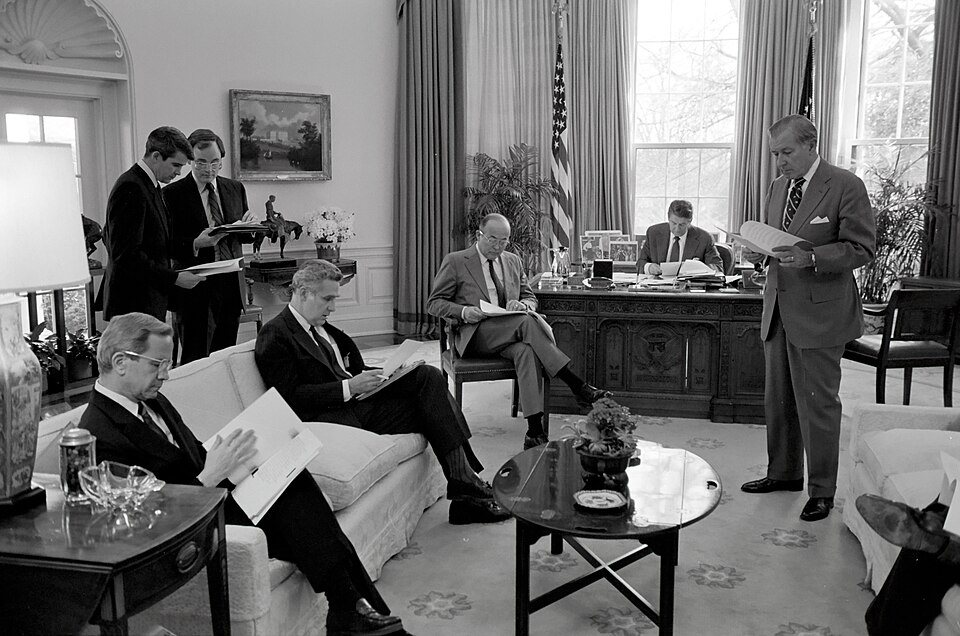
The first shipment went out on August 20, 1985: 96 TOW antitank missiles, sent by Israel with the expectation that the U.S. would replace them. Less than a month later, the Reverend Benjamin Weir, one of the hostages, was released.3
More shipments followed, including Hawk antiaircraft missiles and parts. Marine Lieutenant Colonel Oliver North, a National Security Council aide, proposed selling directly to Iran at a markup and sending part of the money to the Contras. National Security Adviser John Poindexter approved it.3
In May 1986, former National Security Adviser Robert McFarlane flew secretly to Tehran.3 Some hostages were released. Others were taken.
It all comes out
On October 5, 1986, Nicaraguan forces shot down a cargo plane carrying weapons to the Contras. Three of its four crew died. Eugene Hasenfus parachuted out and was captured. Logbooks found in the wreckage linked the flight to an American air cargo company.4
On November 3, a Lebanese magazine, Ash-Shiraa, revealed the arms sales to Iran.3 Ten days later, President Reagan went on television and denied trading arms for hostages.1
Between November 21 and 25, Oliver North destroyed or hid documents. On November 25, Attorney General Edwin Meese announced that profits from the Iran arms sales had been sent to the Contras. North was fired. Poindexter resigned.3
The verdicts
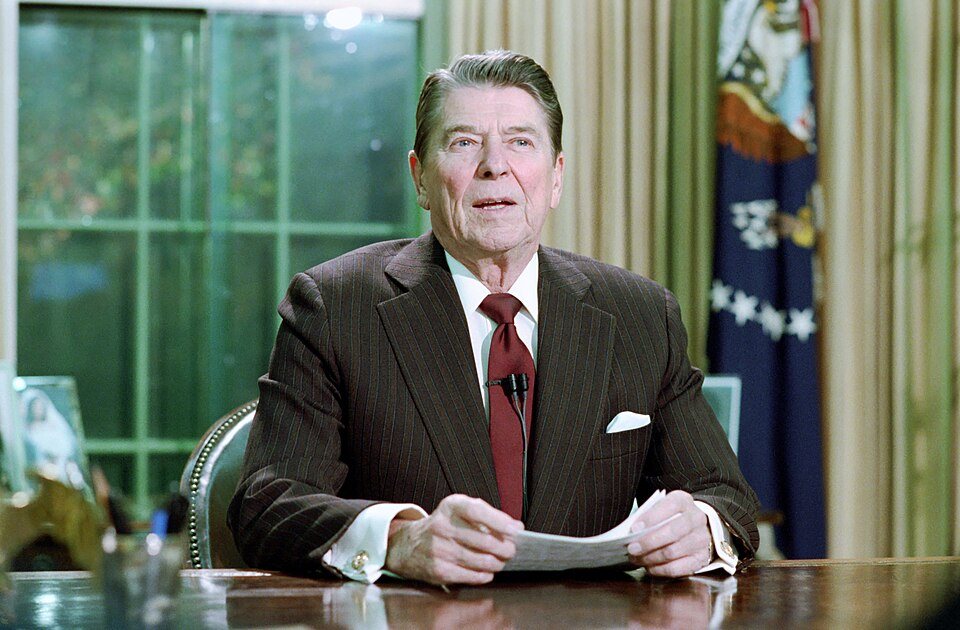
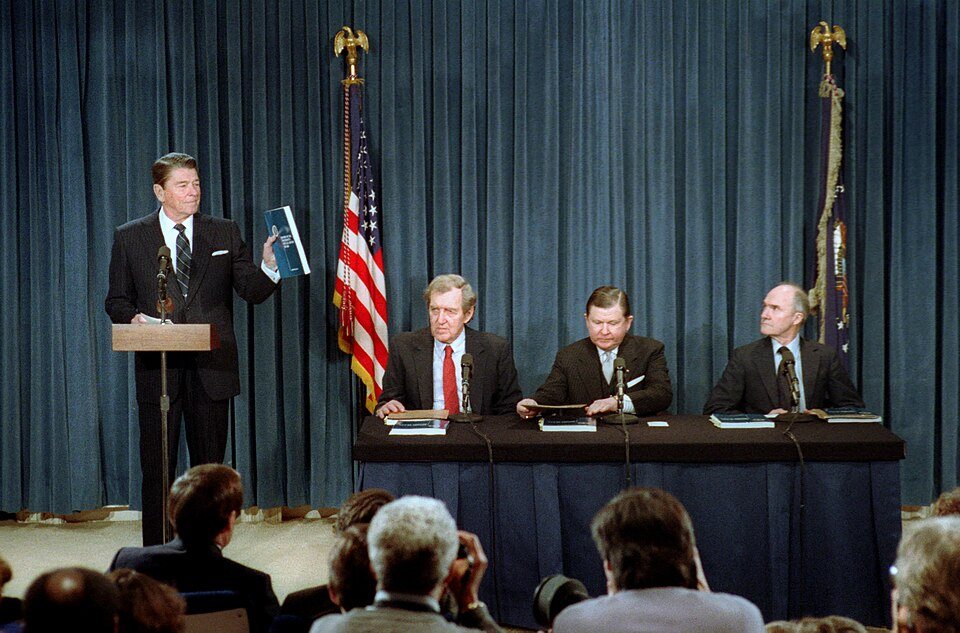
A review board led by former Senator John Tower reported in February 1987. It found that Reagan hadn't known the full extent of the program and criticized how loosely he supervised his staff.3 A week later, Reagan told the nation: "I take full responsibility for my own actions and for those of my administration."2
That summer, Congress held televised hearings. Its final report concluded: "If the president did not know what his national security advisers were doing, he should have."3
North's and Poindexter's convictions were overturned on appeal because their trials may have been tainted by testimony they had given Congress under immunity.3 On December 24, 1992, President George H.W. Bush pardoned former Defense Secretary Caspar Weinberger before his trial, along with five others.35
The paper trail
- Oct 1984Boland AmendmentCongress cuts off U.S. military aid to the Contras.3
- Aug 20, 1985First shipmentIsrael sends Iran 96 TOW missiles.3
- Sep 15, 1985Hostage freedThe Rev. Benjamin Weir is released in Lebanon.3
- May 1986TehranRobert McFarlane flies secretly to Iran.3
- Oct 5, 1986Shot downA Contra supply plane is downed over Nicaragua. Eugene Hasenfus survives.4
- Nov 3, 1986Ash-ShiraaA Lebanese magazine reveals the arms sales.3
- Nov 13, 1986First addressReagan denies trading arms for hostages.1
- Nov 25, 1986The diversionAttorney General Meese announces profits went to the Contras.3
- Feb 26, 1987Tower reportThe review board faults Reagan's management of his staff.3
- Mar 4, 1987Second addressReagan accepts responsibility.2
- Nov 18, 1987CongressThe joint committees issue their final report.3
- Dec 24, 1992PardonsPresident Bush pardons Caspar Weinberger and five others.3
- Aug 4, 1993Final reportIndependent Counsel Walsh submits his final report.35
 Host
"The cover-up worked"
This one isn't a theory. They shredded documents while investigators were on the way.3 The two men at the center got their convictions thrown out. A defense secretary was pardoned before a jury could hear his case. The independent counsel's own final report said senior officials made "a concerted effort to deceive Congress and the public."5
So why stop at what they admitted? A Senate subcommittee found that the State Department paid Contra aid money to companies whose owners had been indicted for drug trafficking, or were under investigation for it.6 The CIA's own inspector general later admitted the agency didn't follow up on drug allegations against its allies.7 When the people in charge were caught lying once, you're entitled to ask what else they never told us.
 Host
"The system found it"
Iran-Contra is proof that secrets come out. A plane crash, a small magazine, a presidential commission, Congress and an independent counsel put it all on the record, with dates, names, convictions and a president admitting on television that the facts contradicted him.23
The bigger claims built on top of it haven't held up the same way. The Senate inquiry found drug smuggling by individual Contras and their suppliers, not by the Contra leadership.6 The CIA inspector general found no CIA role in the crack trade in American cities. "No conspiracy," he said. "That's ineptitude."7 The real scandal is serious enough without them.
Rex and June are characters written for this site and appear in every file. They are not real people. Their arguments come from the sources listed below.
A $10 million typo
The Sultan of Brunei agreed to give $10 million to help the Contras. It never got there.
The Swiss bank account number the money was sent to had been written down wrong, and the $10 million landed in a stranger's account. It was eventually returned, with interest.3
How much did President Reagan know?
On film
Videos about this file from other creators, picked to show more than one side. Tap a tape to play it.
Videos are made by their channels, not by Rumor & Record, and reflect their creators' views. They load from YouTube only when you tap play.
The file
Common questions
What was the Iran-Contra affair?
A secret operation in which Reagan administration officials sold weapons to Iran, partly to win the release of American hostages in Lebanon, and sent profits to the Contra rebels in Nicaragua despite a congressional ban on military aid.
Did Reagan know about Iran-Contra?
Reagan approved the arms sales to Iran. He said he didn't know about the diversion of money to the Contras, and the Tower Commission found he hadn't known the full extent of the program. How much he knew is still debated.
Who was convicted in Iran-Contra?
Eleven of the 14 people charged by Independent Counsel Lawrence Walsh were convicted. Oliver North's and John Poindexter's convictions were overturned on appeal, and President George H.W. Bush pardoned six people in 1992.
Was the CIA involved in drug trafficking during Iran-Contra?
A 1989 Senate report found evidence of drug smuggling by individual Contras and their suppliers. A 1998 CIA inspector general report found the agency failed to follow up on some allegations but found no CIA role in the U.S. crack trade.
Other open files
Sources
- Address by President Reagan to the Nation, November 13, 1986 (Foreign Relations of the United States, U.S. Department of State)
- Address by President Reagan to the Nation, March 4, 1987 (Foreign Relations of the United States, U.S. Department of State)
- Iran–Contra affair (Wikipedia)
- Corporate Air Services HPF821 (Wikipedia)
- Conclusions of the Independent Counsel's final report, 1993 (North Carolina State University, course reader)
- Kerry Committee report (Wikipedia)
- The CIA and drug trafficking (PBS Frontline)
The Bermuda Triangle
Five Navy bombers took off from Fort Lauderdale on a clear afternoon in 1945. The flight leader radioed that his compasses were out. Then the plane sent to find them vanished too.
Open file 008Photo credits: All photographs: White House Photographic Office, Ronald Reagan Presidential Library (public domain). Full list on the credits page.