Rumor & Record
The case for. The case against. You decide.
EVIDENCE Case open

Bigfoot

Case no.018, Cryptids
Also calledSasquatch
Named1958, Humboldt County, California
Reported sightingsMore than 10,000 in the U.S.
Exhibits4, from 1958 to 2024

In 1967, two men on horseback in the forests of Northern California filmed less than a minute of something walking along a creek. It was tall, covered in dark hair, and it . That film is still the most argued-over evidence for Bigfoot, and in 2026, a reel found in a safe set the argument on fire again.3

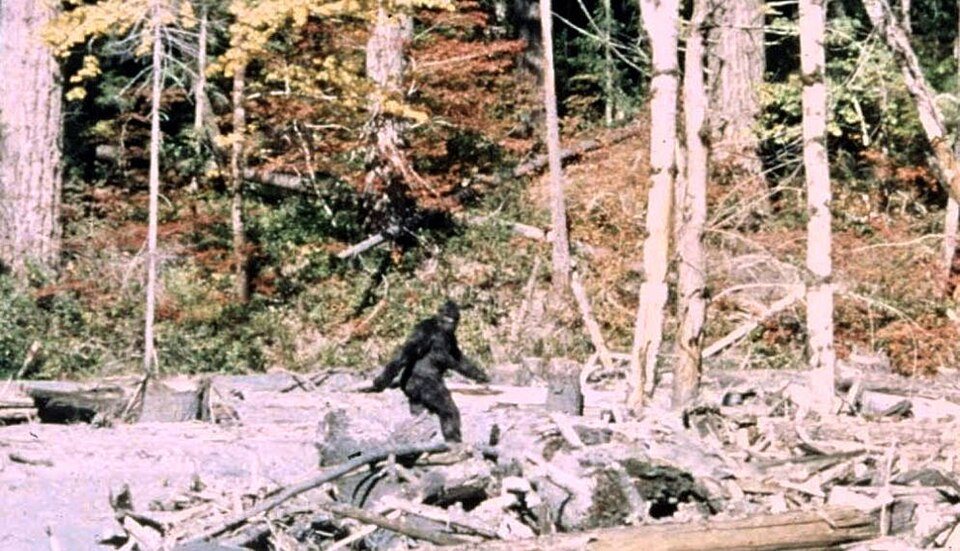
A grainy film frame of a tall, dark, hairy figure walking across a sandbar by a creek, its head turned toward the camera.
Exhibit 018-A Frame 352 of the Patterson-Gimlin film, October 1967Roger Patterson and Robert Gimlin, public domain

Weigh the evidence

0 of 4 rated

Four pieces of evidence that come up in almost every Bigfoot argument. Look at each one and give your first impression. Then read both explanations. You can change your answer any time.

CASE FILE 018CHAPTER 1

A name from a newspaper

In August 1958, a bulldozer operator named Jerry Crew found huge, bare footprints around his rig in Humboldt County, California. He took them to reporter Andrew Genzoli of the Humboldt Times, whose stories gave the tracks a name: Bigfoot.1

The idea was older than the name. In a 1929 article in Maclean's, teacher J.W. Burns introduced the word "Sasquatch," believed to come from a word in the Halq'emeylem language meaning roughly "hairy man."1

10,000+reported Bigfoot sightings in the continental United States.

About 1 in 10 American adults said in a 2020 poll that Bigfoot is "a real, living creature."1

CASE FILE 018CHAPTER 2

Sixty seconds at Bluff Creek

Roger Patterson and Bob Gimlin said they shot their film on October 20, 1967, along a tributary of the Klamath River in Northern California. It runs 954 frames, about 59.5 seconds at 16 frames per second.3

Frame 352, where the figure looks back over its shoulder, became one of the most famous images of the century. Because the film was published without a copyright notice, it's in the public domain in the U.S.3

Patterson died in 1972 and "maintained right to the end that the creature on the film was real." Gimlin has always denied a hoax.3

In 1999, Bob Heironimus went public, saying he had worn the suit. A costume maker, Philip Morris, said he had sold Patterson an ape suit, but offered no evidence beyond his own word.3

CASE FILE 018CHAPTER 3

The wooden feet

Ray Wallace, a logging contractor, died in November 2002 at 84. Then his family made an announcement: he had been behind the 1958 tracks.2

They said a friend carved him a pair of 16-inch feet from alder wood, and that Wallace and his brother wore them to make the prints. "Ray L. Wallace was Bigfoot," one family member said. "The reality is, Bigfoot just died."2

Not everyone accepted it. Meldrum said "simple carved feet strapped to boots just doesn't wash," and pointed to Bigfoot-like accounts from the 1800s.2

CASE FILE 018CHAPTER 4

A reel in a safe

In March 2026, the documentary Capturing Bigfoot premiered at the South by Southwest festival. It's built around a 16 mm reel found in a locked safe that belonged to a man who had worked at a Boeing film lab.4

Director Marq Evans says the reel holds a 40-second clip "produced and developed" in 1966, a year before the famous film, showing a skinnier Bigfoot walking through similar woods. The film presents it as a rehearsal.4

Patterson's son, Clint, says his mother told him the 1967 sighting was a hoax. Heironimus repeated that he wore the suit, though he has given inconsistent accounts in the past.4

The Bigfoot world pushed back. Matt Moneymaker of the Bigfoot Field Researchers Organization asked how anyone could trust the footage "in the age of AI." Meldrum, who appears in the film, still sees "real mammalian musculature" in the 1967 figure. Evans says no AI was used.4

Illustrated portrait of Rex Marlowe, host of the believer case: a weathered man in a canvas field jacket.Host
Personnel file / Statement ARex MarloweThe believer caseHosted an overnight radio show about the unexplained for 20 years. Now he goes to the places in the files.

"Too many people, too many prints"

More than ten thousand people in this country have reported seeing it.1 The name Sasquatch comes from an Indigenous word for a hairy man of the woods, long before any prankster's wooden feet.1 And a working anthropologist has more than 300 footprint casts he says no carving or human foot could make.1

Then there's the film. Patterson never backed down, and Gimlin never has.3 Even now, a scientist who has studied it for decades says he sees muscle moving under that hair.4 A hoax claim from a man who has changed his story before doesn't erase a minute of film nobody has ever recreated exactly.

Illustrated portrait of June Okafor, host of the skeptic case: a woman in a blue work shirt holding manila folders.Host
Personnel file / Statement BJune OkaforThe skeptic caseSpent ten years as an insurance fraud investigator. Now she reads the original records so you don't have to.

"Every exhibit points back to people"

The name Bigfoot comes from 1958 tracks that the prankster's own family says he made with carved feet.2 A man says he wore the suit in the 1967 film, and now there's a reel that appears to show a practice run a year earlier.3

When samples get tested, they come back ordinary: the FBI found deer hair, and a 2014 study found bears and one human.5 The giant ape people point to lived in China and died out more than 200,000 years ago.6 After all these sightings, there's still no body, no bones and no teeth.

Rex and June are characters written for this site and appear in every file. They are not real people. Their arguments come from the sources listed below.

THE STRANGEST PART

It's a crime to kill one

In 1969, a county in Washington state made killing a Bigfoot a felony, with a fine of up to $10,000 or five years in prison.1

In 1984 the crime was reduced to a misdemeanor, and the whole county was declared a "Sasquatch refuge."1 And in 2025, Bigfoot got its own emoji, posed like the figure in the 1967 film.3

READER FINDINGCASE FILE 018

Is there something out there?

Mark one box to see how other readers voted.

On film

Videos about this file from other creators, picked to show more than one side. Tap a tape to play it.

FOX 13 Seattle3:36Watch on YouTube
The Backcountry Manifesto PodcastWatch on YouTube
KPTV FOX 12 Oregon9:05Watch on YouTube

Videos are made by their channels, not by Rumor & Record, and reflect their creators' views. They load from YouTube only when you tap play.

The file

Named1958, Humboldt County, California
Famous filmPatterson-Gimlin, October 20, 1967
Physical proofNo body, bones or confirmed DNA
StatusNot recognized by science. Still argued.

Common questions

Is Bigfoot real?

There's no confirmed physical evidence, such as a body, bones or DNA, and expert consensus is that claims of Bigfoot's existence are not credible. Believers point to footprint casts, the 1967 film and thousands of reported sightings.

Was the Patterson-Gimlin film faked?

It's disputed. Roger Patterson maintained it was real until his death, and Bob Gimlin has always denied a hoax. Bob Heironimus says he wore the suit, and a 2026 documentary presents a 1966 reel it calls a rehearsal.

Where did the name Bigfoot come from?

From the Humboldt Times in 1958, after bulldozer operator Jerry Crew found large footprints in Northern California. Ray Wallace's family later said he made those tracks with carved wooden feet.

Did the FBI investigate Bigfoot?

The FBI tested a hair sample in 1977 at a researcher's request and found it was "of deer family origin." It released the file in 2019.

Other open files

031 / PRINCESS DIANA NEXT FILE: DEATHS & DISAPPEARANCES

Princess Diana

A black Mercedes left the back door of the Ritz in Paris just after midnight. Three minutes later it hit a pillar in a riverside tunnel.

Open file 031

Photo credits: Patterson-Gimlin film frames (public domain); footprint casts, Fred Cherrygarden (CC BY-SA 4.0); FBI Bigfoot file (public domain); Gigantopithecus jaw cast, James St. John (CC BY 2.0). Full list on the credits page.