 Rumor & Record
MEMORANDUM / FILE 047
Roswell
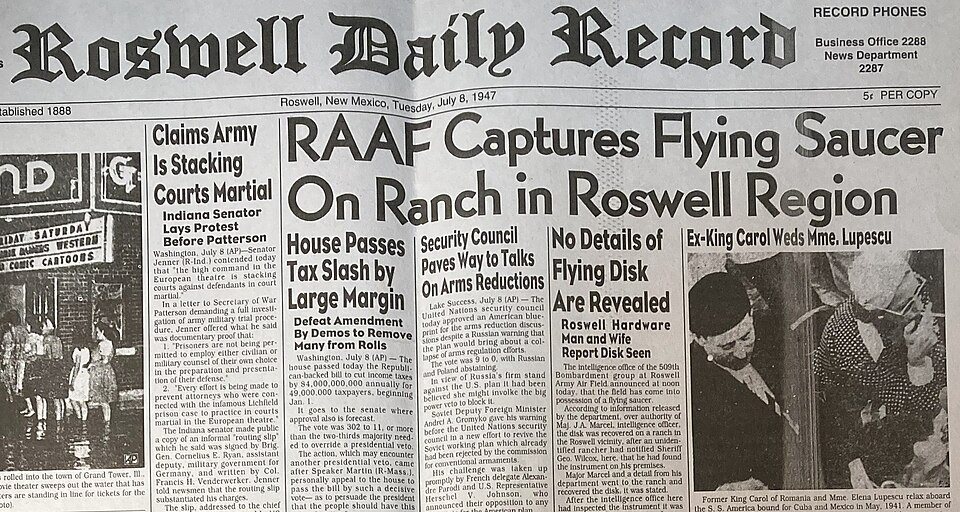
On July 8, 1947, the U.S. Army put out a press release saying it had recovered a flying disc. A day later, the story changed to a weather balloon. Forty-seven years later, the Air Force admitted the weather balloon was .1
Declassify the records
0 of 6 declassifiedTwo documents, 48 years apart: the Army's own 1947 press release, and a 1995 report by Congress's investigators on what records were left. These lines are exact. We blacked out key words. Tap each bar to declassify it.
PRESS RELEASE, JULY 8, 1947. The many rumors regarding the became a reality yesterday when the intelligence office of the 509th Bomb group of the Eighth Air Force, Roswell Army Air Field, was fortunate enough to gain possession of a disc through the cooperation of one of the local ranchers and the sheriff's office of Chaves County.
PRESS RELEASE, JULY 8, 1947. The flying object landed on a ranch near Roswell .
PRESS RELEASE, JULY 8, 1947. Not having phone facilities, the rancher stored the disc until such time as he was able to contact the sheriff's office, who in turn notified of the 509th Bomb Group Intelligence Office.
GAO, JULY 28, 1995. Our search for government records concerning the Roswell crash yielded originating in 1947.
GAO, JULY 28, 1995. For example, RAAF administrative records (from Mar. 1945 through Dec. 1949) and RAAF outgoing messages (from Oct. 1946 through Dec. 1949) .
GAO, JULY 28, 1995. The document disposition form does not indicate and when or under what authority the records were destroyed.
Sources: the 1947 press release as quoted in the historical record, and U.S. General Accounting Office report GAO/NSIAD-95-187. Both U.S. government documents in the public domain.12
Debris on the ranch
In June 1947, a rancher named Mac Brazel found a field of strange debris on the ranch he worked near Corona, New Mexico: tinfoil, rubber, tape and thin wooden beams.1
Around July 6, he brought it to Sheriff George Wilcox in Roswell. The sheriff called Roswell Army Air Field, which sent Major Jesse Marcel and Captain Sheridan Cavitt to collect the material.1
On July 8, the base's public information officer, Walter Haut, issued the press release that made Roswell famous.1
A balloon, said the general
The disc didn't last. General Roger Ramey, Colonel Thomas DuBose and a weather officer, Irving Newton, identified the material as the remains of a weather balloon.1
On July 9, the Roswell Daily Record reported that no engine or metal parts had been found. On July 10, officers at Alamogordo gave reporters a demonstration of the weather balloon story.1
For three decades, that was the end of it.
The story comes back
In 1978, UFO researcher Stanton Friedman interviewed Jesse Marcel. Marcel called the weather balloon explanation a cover story and said he now believed the debris was extraterrestrial.1
In 1980, Charles Berlitz and Bill Moore published The Roswell Incident, which spread Marcel's account and added claims that alien bodies had been recovered.1
The Air Force answers
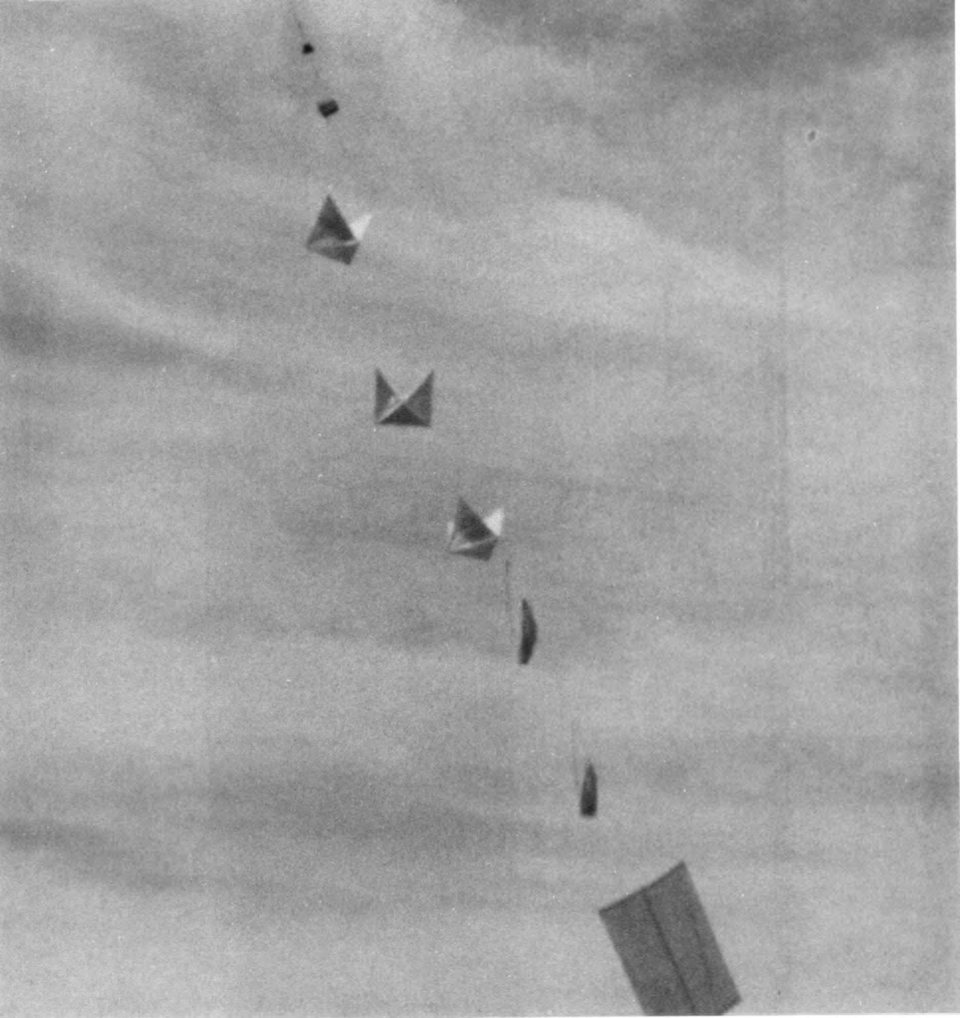
In 1993, a congressman asked the government's investigators to find the records.12 In 1994, the Air Force published its own report. It said the debris most likely came from Project Mogul, a classified program that flew trains of balloons carrying instruments to detect Soviet nuclear tests, and it admitted that the weather balloon explanation was a cover story for Mogul.12
Mogul Flight No. 4 was launched from Alamogordo on June 4, 1947, drifted toward Corona and was lost within about 17 miles of Brazel's ranch.1
In 1997, a second Air Force report, The Roswell Report: Case Closed, took on the alien bodies. It said those accounts most likely came from memories of military accidents and of test dummies.13
The paper trail
- Jun 4, 1947Mogul Flight 4A secret balloon train is launched from Alamogordo and lost near Corona.1
- Jun 1947The ranchMac Brazel finds tinfoil, rubber, tape and wooden beams.1
- Jul 8, 1947Press releaseRoswell Army Air Field announces it has a "flying disc."1
- Jul 1947Weather balloonGeneral Ramey's office says it was a weather balloon.1
- 1978Marcel speaksJesse Marcel calls the balloon story a cover.1
- 1980The bookThe Roswell Incident adds claims of alien bodies.1
- 1993Congress asksRep. Steven Schiff asks investigators to find the records.1
- 1994Air Force reportProject Mogul. The weather balloon story was a cover.1
- Jul 28, 1995GAO reportTwo 1947 records found. Others destroyed, by whom unknown.2
- Jun 24, 1997Case ClosedThe Air Force explains the alien-body stories as test dummies and accidents.1
 Host
"They changed the story twice"
The Army didn't say "weather balloon" first. It said "flying disc," in writing, in its own press release.1 Then it took it back within a day. Then, 47 years later, the Air Force admitted the weather balloon was a cover story.1 If they lied once to protect a secret, why trust the second explanation?
And look at what's missing. The base's outgoing messages from that whole period were destroyed, and nobody can say who destroyed them, when, or on whose authority.2 The officer who picked up the debris said it was extraterrestrial.1 When the paper trail disappears, the people who were there are all we have.
 Host
"The secret was real. It just wasn't aliens."
Yes, the military lied in 1947, to protect Project Mogul, a classified program to spy on Soviet nuclear tests.1 A Mogul balloon train was lost about 17 miles from the ranch weeks before Brazel's find, and what he found was tinfoil, rubber, tape and wooden beams.1
The FBI's own message from July 8, 1947, described the object as "a high-altitude weather balloon with a radar reflector."2 The alien bodies didn't enter the story until a book published 33 years later.1 A cover-up of a spy balloon is still a cover-up, but it's not a spaceship.
Rex and June are characters written for this site and appear in every file. They are not real people. Their arguments come from the sources listed below.
The crash that built a town's economy
Roswell's International UFO Museum and Research Center opened in 1991. Since 1995, the town has held a UFO festival every year.1
About 90,000 tourists come each year, many of them to see the place where, according to the Air Force, a balloon came down.1
What crashed near Roswell in 1947?
On film
Videos about this file from other creators, picked to show more than one side. Tap a tape to play it.
Videos are made by their channels, not by Rumor & Record, and reflect their creators' views. They load from YouTube only when you tap play.
The file
Common questions
What happened at Roswell?
In 1947, a rancher found debris near Corona, New Mexico. Roswell Army Air Field announced it had recovered a "flying disc," then said it was a weather balloon. In 1994, the Air Force said it was a classified Project Mogul balloon train and admitted the weather balloon story was a cover.
Were alien bodies found at Roswell?
No records show it. Claims of bodies first appeared in a 1980 book. A 1997 Air Force report attributed them to memories of military accidents and test dummies.
What was Project Mogul?
A classified program that flew long trains of balloons carrying instruments meant to detect Soviet nuclear tests. A Mogul flight launched on June 4, 1947, was lost near the ranch where the debris was found.
Were Roswell records destroyed?
Yes. A 1995 GAO report found that Roswell Army Air Field's administrative records from 1945 to 1949 and outgoing messages from 1946 to 1949 had been destroyed, without a record of who destroyed them or under what authority.
Other open files
Sources
- Roswell incident (Wikipedia)
- Results of a Search for Records Concerning the 1947 Crash Near Roswell, New Mexico (GAO/NSIAD-95-187) (U.S. General Accounting Office, 1995)
- Roswell UFO: what really happened (History.com)
Dyatlov Pass
In February 1959, nine hikers in the Ural Mountains cut their way out of their own tent and walked into the snow, some of them without shoes. None of them came back.
Open file 072Photo credits: Roswell Daily Record, July 8, 1947 (public domain); Project Mogul balloon train, U.S. Air Force (public domain). Full list on the credits page.