 Rumor & Record
MEMORANDUM / CASE FILE 082
Kill
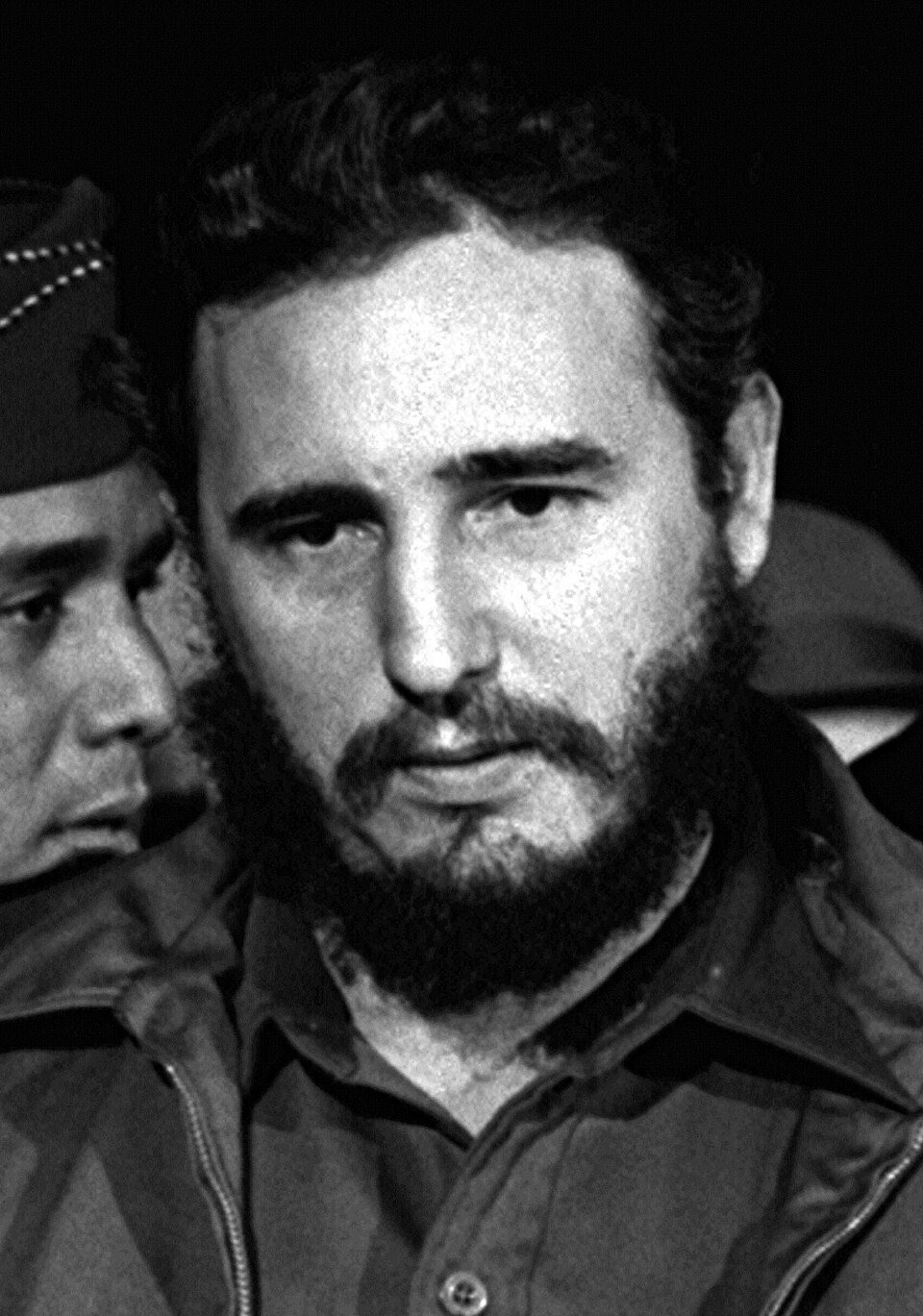
Castro
In September 1960, in a New York hotel, a man working for the CIA offered a mobster $150,000 for a job in Havana. The target was Fidel Castro. It was the start of five years of plots involving poison pills, gangsters and a fountain pen with a needle in it, all of it confirmed by .12
Declassify the findings
0 of 6 declassifiedIn 1975, a Senate committee led by Senator Frank Church published what it had found about U.S. plots against foreign leaders. These lines from its report are exact. We blacked out key words. Tap each bar to declassify it.
SUMMARY. Fidel Castro (Cuba).—United States Government personnel plotted to kill Castro .
SUMMARY. and Cubans hostile to Castro were used in these plots, and were provided encouragement and material support by the United States.
SUMMARY. The Castro and Lumumba cases are examples of to kill foreign leaders.
SUMMARY. The Committee finds that the system of executive command and control was so ambiguous that it is difficult to be certain at what levels assassination activity was .
SUMMARY. Whether or not the respective Presidents knew of or authorized the plots, as chief executive officer of the United States, each must bear for the activities of his subordinates.
INTRODUCTION. The Committee believes that, short of war, assassination is .
Source: U.S. Senate Select Committee on Intelligence Activities (the Church Committee), Alleged Assassination Plots Involving Foreign Leaders, 1975. A U.S. government document in the public domain.2
A contract in New York
In September 1960, the CIA reached out, indirectly, to the Mafia. On September 14, at a New York hotel, a go-between working for the agency, Robert Maheu, offered mobster Johnny Roselli $150,000 for Castro's "removal." Roselli was the link to two Mafia bosses, Sam Giancana and Santo Trafficante.1
Giancana suggested poison, something that could go in Castro's food or drink. The CIA's Technical Services Division made the pills. They were passed to a Cuban official said to have access to Castro, who tried and failed, then asked to be let out.1
A second try used botulinum toxin pills meant for a restaurant Castro visited. It was called off when Castro stopped going there and the Bay of Pigs invasion began.1
Highest priority
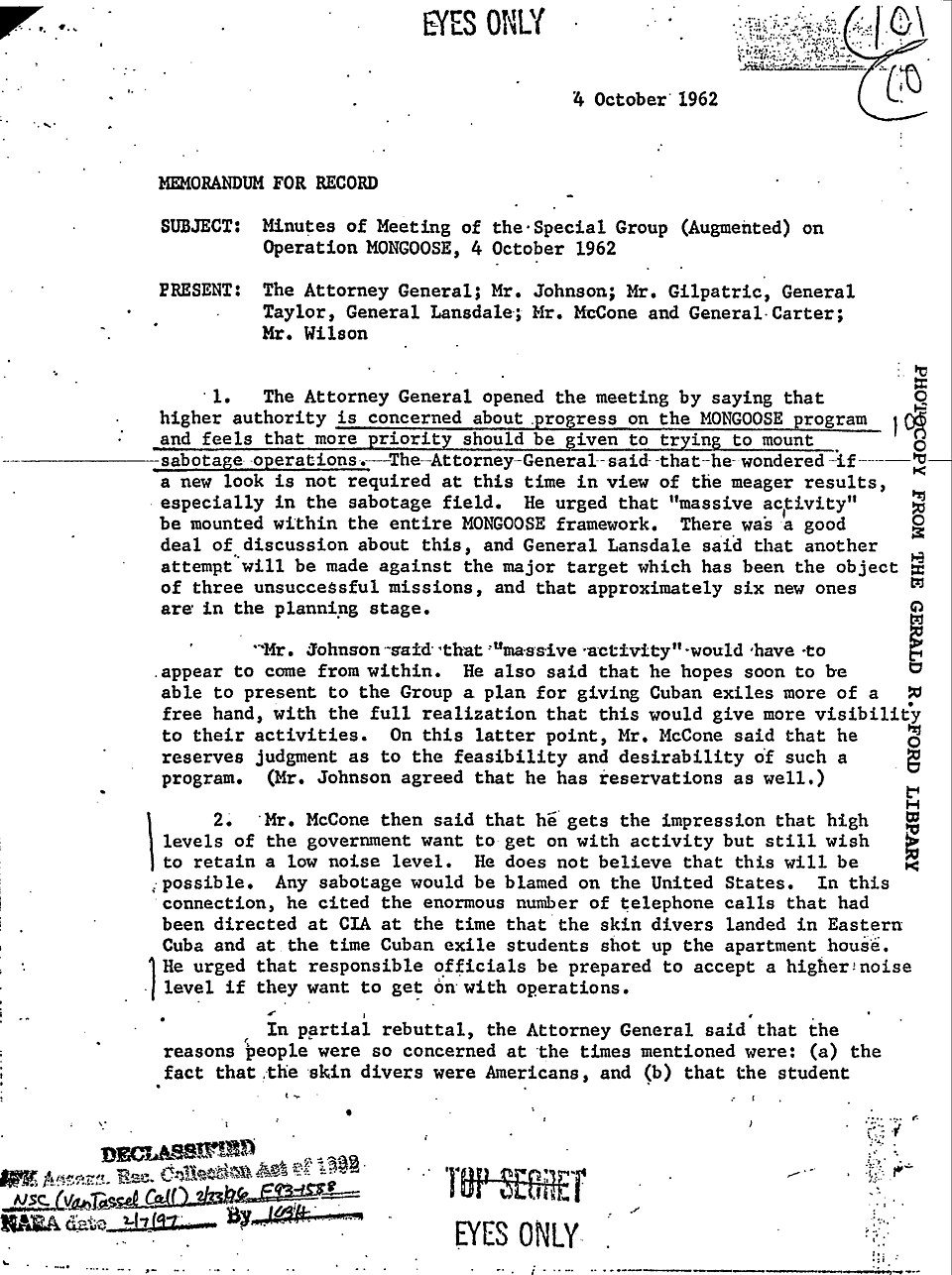
After the Bay of Pigs failed, President Kennedy created a new covert program against Cuba on November 30, 1961. It became Operation Mongoose, led by Edward Lansdale from his post at the Pentagon.3
In February 1962, Attorney General Robert Kennedy told the group overseeing it that Cuba had become the "highest priority of the United States." Lansdale's plan laid out 32 tasks for different agencies, and six phases ending with an open revolt in October 1962.3
At an August 1962 meeting, Defense Secretary Robert McNamara reportedly raised the idea of liquidating Castro. After the Cuban Missile Crisis that October, Mongoose missions were stopped.3
The pen in Paris
One of the CIA's important Cuban assets in these plots was Rolando Cubela, a commander in Castro's own revolution, code-named AM/LASH.4
On November 22, 1963, at a meeting in Paris, Cubela was given a "poison pen": a fountain pen fitted with a hypodermic needle, meant for Castro. That same day, President Kennedy was assassinated in Dallas.4
The CIA cut ties with Cubela in June 1965. In February 1966, Castro had him arrested for plotting to kill him. He was sentenced to 25 years, pardoned in 1979, and died in Florida in 2022.4
The Senate finds out
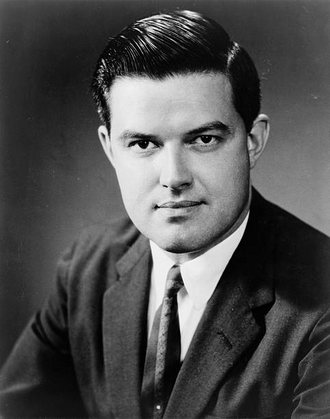
The plots stayed secret for more than a decade. In 1975, a Senate committee chaired by Senator Frank Church investigated, and published what it found about plots against foreign leaders.2
Other schemes the CIA considered included poisoned cigars and a booby-trapped conch shell placed on the sea floor.1
Castro outlived them all. He died of natural causes in 2016, at 90. He once said that "if surviving assassination attempts were an Olympic event, I would win the gold medal."1
The paper trail
- Sep 14, 1960The offerRobert Maheu offers Johnny Roselli $150,000 for Castro's "removal."1
- Apr 1961Called offA poison-pill plot ends as the Bay of Pigs invasion begins.1
- Nov 30, 1961MongooseKennedy creates a new covert program against Cuba.3
- Feb 1962PriorityRobert Kennedy calls Cuba the "highest priority of the United States."3
- Aug 10, 1962LiquidationMcNamara reportedly raises killing Castro at a Mongoose meeting.3
- Oct 30, 1962Stand-downAfter the missile crisis, Mongoose missions are halted.3
- Nov 22, 1963The penA CIA officer gives Rolando Cubela a poison pen in Paris. Kennedy is killed that day.4
- Feb 28, 1966ArrestCastro has Cubela arrested.4
- 1975Church CommitteeThe Senate confirms plots to kill Castro from 1960 to 1965.2
- 2016Castro diesCastro dies of natural causes at 90.1
 Host
"It went to the top, and they made sure it couldn't be proven"
This isn't a theory. The Senate said it in plain words: U.S. government personnel plotted to kill Castro for five years, with the Mafia's help.2 The attorney general called Cuba the "highest priority of the United States."3 The defense secretary reportedly raised liquidating Castro in a meeting.3
And the system was built so no one at the top would ever have to sign anything. The committee itself called the chain of command "so ambiguous" it couldn't be certain who authorized what.2 That's not an accident. That's "plausible deniability" doing its job. Cuba's own counterintelligence chief counted 638 schemes.1 The five years the Senate confirmed may only be the part that got written down.
 Host
"Confirmed, and limited to what the evidence shows"
The plots are real, and the Senate put them on the record in 1975.2 That's exactly what makes the evidence worth reading carefully. The committee could not say for certain that any President authorized them.2 It held them responsible anyway, as the men in charge.2
The bigger numbers are a different kind of claim. The 638 figure comes from Cuba's own security service, and it counts schemes as well as attempts.1 The CIA's best-documented asset was cut loose in 1965, and arrested by Castro the next year.4 The record shows real plots in a specific window, and the target died of old age.1
Rex and June are characters written for this site and appear in every case file. They are not real people. Their arguments come from the sources listed below.
The same day
On November 22, 1963, in Paris, a CIA officer handed Rolando Cubela a pen with a hidden needle, meant to poison Fidel Castro.4
That same day in Dallas, President John F. Kennedy was shot and killed. The plot against Castro and the assassination of the President happened on the same day, an ocean apart.
How high did the Castro plots go?
On film
Videos about this case file from other creators, picked to show more than one side. Tap a tape to play it.
Videos are made by their channels, not by Rumor & Record, and reflect their creators' views. They load from YouTube only when you tap play.
The case file
Common questions
Did the CIA try to kill Fidel Castro?
Yes. In 1975, a Senate committee led by Senator Frank Church found that U.S. government personnel plotted to kill Castro from 1960 to 1965, with help from Mafia figures and anti-Castro Cubans.
Did the CIA work with the Mafia to kill Castro?
Yes. In 1960, CIA go-between Robert Maheu offered Johnny Roselli $150,000 for Castro's "removal," and Sam Giancana and Santo Trafficante were brought in. Poison pills were made for the plot.
How many times did the U.S. try to kill Castro?
The Senate confirmed plots from 1960 to 1965. A former Cuban counterintelligence chief, Fabián Escalante, claimed 638 schemes or attempts, a figure that includes plans as well as attempts.
Did President Kennedy order Castro's assassination?
Unproven. The Church Committee said the chain of command was too ambiguous to be certain who authorized the plots, but held each President ultimately responsible for his subordinates.
Other open case files
Sources
- CIA assassination attempts on Fidel Castro (Wikipedia)
- Alleged Assassination Plots Involving Foreign Leaders (S. Rept. 94-465) (U.S. Senate, Church Committee, 1975)
- Kennedy, Cuba and Operation Mongoose (National Security Archive, 2019)
- Rolando Cubela Secades (Wikipedia)
The Stanford Prison Experiment
In 1971, students in a Stanford basement became guards and prisoners, and it all fell apart in six days. Then the tapes came out.
Open case file 098Photo credits: Fidel Castro in Washington, Warren K. Leffler (public domain); Operation Mongoose minutes (public domain); Senator Frank Church, U.S. Congress (public domain). Full list on the credits page.